As we known by now, ERP programs are major investments a company makes, yet many still fall short of expectations. After go-live, daily work feels heavier, hypercare stretches into months, and business users begin to ask why the new solution seems more complicated than the old one.
The problem isn’t always the technology. The problem is that the project was scoped too narrowly?
This becomes clear when looking at a framework I use to assess transformation readiness:
the Operating Model Enablement Venn (OME Venn)
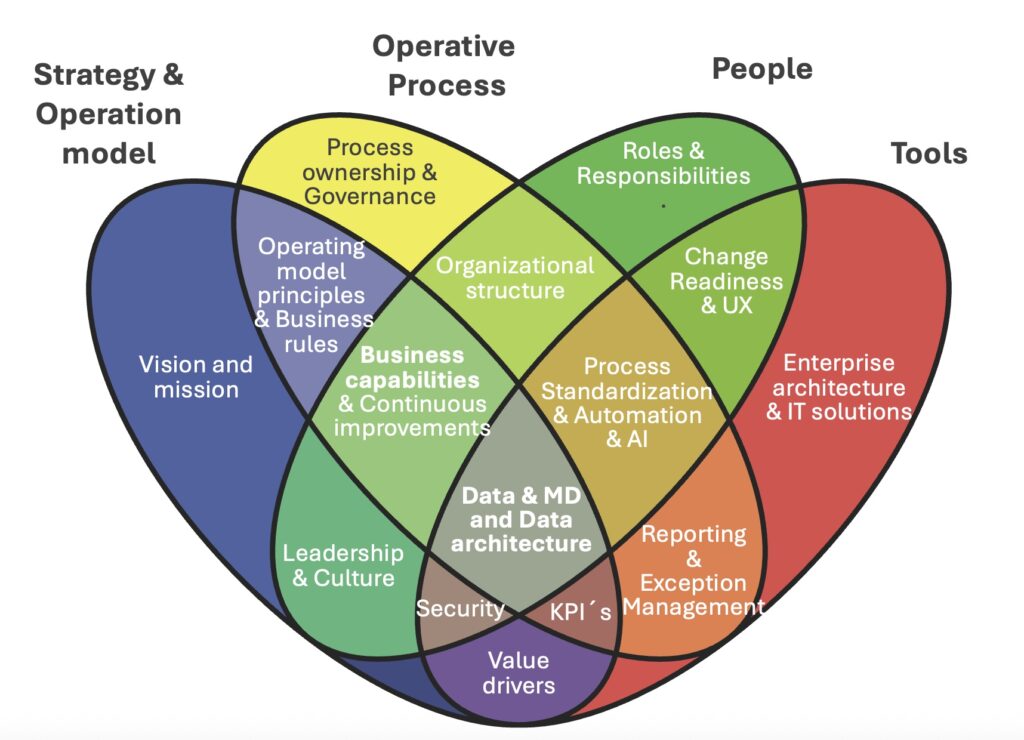
What Is the Operating Model Enablement Venn (OME Venn)
The OME Venn highlights the four domains that must evolve together for any ERP-driven change to succeed:
- Strategy & Operating Model
- Operative Processes
- People & Capabilities
- Tools (Technology)
ERP success happens in the overlapping center — where all four domains align.
Failure happens when the project focuses mainly on Tools + basic transactional training and partial testing, while the rest of the model remains underdeveloped. This is the root cause of many ERP challenges: projects are executed as technology upgrades instead of operating model transformations.
What Happens When Only Part of the OME Venn Is Addressed?
When the other domains are ignored and the focus stays mainly on technology, the same problems almost always appear:
- ERP, EWM or IBP feel “too complex” to use
- planning cannot meet the accuracy the system expects
- operative processes require extra manual work to function
- users return to old workarounds in daily operations
- hypercare lasts far longer than planned
- the expected business value never materializes
These are not system defects. They are gaps in the Operating Model Enablement Venn.
How ERP Projects Should Actually Be Delivered?
To make the four domains move in the same direction, ERP programs must shift from system deployment to operating model deploy and enablement. The following principles support this shift:
1. Treat ERP as a business transformation — not an IT implementation. Start with the operating model, roles, and decision-making logic. Let technology enable them, not define them.
2. Use the OME Venn as the core design Strategy, processes, people, and tools must be developed in parallel, not in sequence.
3. Establish accountable business ownership If business does not own the solutions for operative processes, it cannot own the outcomes.
4. Assess organizational maturity realistically during the project.
If data governance, capabilities or process discipline are not ready for full complexity, the solution must be simplified rather than forced through. At the same time, missing business capabilities must be actively developed so the organization’s maturity can rise to the level required to realize value.
Check Pathfinder´s blog related honesty Honesty Is the Hardest Currency in Development? related What is actually changing in everyday work, for whom, and why?
5. Simulate key operational scenarios before go-live End-to-end walkthroughs, planning games, warehouse day-in-the-life “table” simulations and role-based rehearsals build the understanding that training alone cannot create. what and why and what is the change need to be clear.
Lasting Takeaway
The Operating Model Enablement Venn reminds us that ERP success is not about deploying a system — it is about enabling a new way of working. When strategy, processes, people, and technology evolve together, ERP becomes not just a tool, but a continuous source of business value.
0 Comments